Happening Now
Expansion: Another Reason You Should Care About The UPNS Merger
June 12, 2026
By Jim Mathews / President & CEO
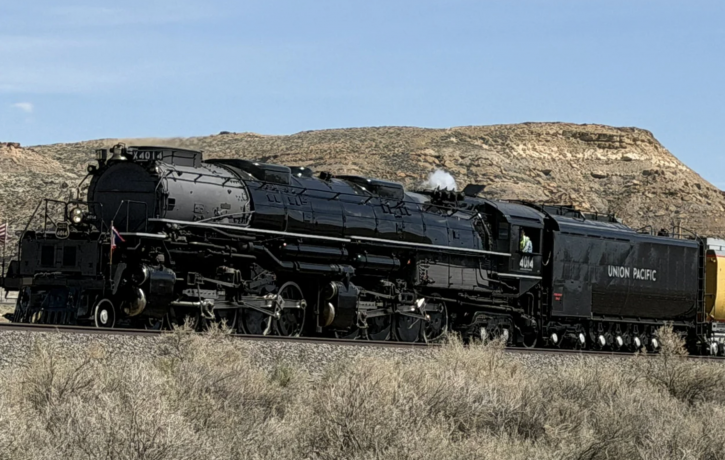
Now that regulators are in a two-month pause evaluating Union Pacific’s proposed acquisition of Norfolk Southern, no doubt their respective boardrooms are happy to see the companies’ names attached more to positive news than worries about the future -- Union Pacific’s majestic Big Boy locomotive chugging impressively across Norfolk Southern territory before tens of thousands in excited crowds.
But that doesn’t change the future, nor does it diminish the urgency of the questions we need to ask about this proposed mega-merger. “Will this deal make it harder to build the passenger rail network Congress is already paying to plan?” We already kind of knew the answer, but thanks to your Association’s team of data scientists and researchers, today we can emphatically declare, “Yes, without a doubt.”
Last winter, Rail Passengers warned that a merged Union Pacific-Norfolk Southern railroad would control much of America's future passenger rail map. I told you then that our teams would keep working through filings and documents filed to the Surface Transportation Board docket, and that we’d keep you informed as we learned and understood better.
This week, our team just put the finishing touches on its analysis of the overlap with the Federal Corridor Identification program, comparing UPNS’ projected freight growth with corridors currently being examined under Corridor ID, sharing it with our coalition partners working on litigation over the transaction. Our analysts compared the applicants' own projected freight growth with the corridors that the Federal Railroad Administration is planning -- and which Congress is paying for. Unsurprisingly, we found many places where future passenger expansion and future freight growth would compete for the same capacity. Nearly everywhere in the country, you probably live in a place where the new train service you want to see could get crimped or even vetoed by a combined Union Pacific-Norfolk Southern railroad.
Do you want more and better trains in the U.S. Southeast? Well, the proposed Charlotte-Atlanta Corridor would operate over Norfolk Southern territory where the applicants project at least eight additional freight trains every day across multiple route segments.
Have you been pining for Ohio’s long-promised “three Cs and D” (Cleveland, Columbus, Dayton, and Cincinnati)? Or Toledo to Detroit? Those projects overlap with territory where the applicants project six additional freight trains under their Operating Plan and another train under their Growth Plan.
Excited about the Mardi Gras? Our closely watched and wildly successful new Amtrak Mardi Gras between New Orleans and Mobile would operate over a segment where UPNS project eight additional freight trains. You might remember that when we were all fighting about the Mardi Gras the railroads argued that adding just two daily trains would cost a billion dollars in additional capital investment...just sayin’.
Want more and better trains in Pennsylvania? Or the Lackawanna Cutoff? The Keystone Corridor west of Harrisburg? That territory would host a projected seven additional freight trains.
Commute in California? The LOSSAN Corridor in Southern California, already among the nation's busiest passenger rail corridors, appears alongside projected freight growth in the Los Angeles terminal area.
Disclosures in the UP and NS filings before the STB show they expect to operate 89 new freight trains across places now accepted into the congressionally directed and FRA-led Corridor ID program. Overall, we found 182 new daily trains across all Amtrak routes’ territories, and 29 in important commuter areas like Chicago’s Metra and California’s Metrolink.
Am I arguing that these projects can’t coexist? No, not necessarily. And don’t say that I am. But one of our most enduring criticisms of the entire UPNS application is that the two railroads have devoted hundreds of pages to explaining why the merger won’t adversely affect today's passenger trains, while devoting zero attention to explaining how their future freight growth plans interact with the future passenger rail network now being planned across the United States.
Moreover, they generally claim they can do this with no or minimal new capital investment, mostly relying on existing capacity and -- in a handful of places -- public investment (read, “taxpayer dollars”) already programmed and underway. That’s a pretty dramatic departure from the typical claims that even a single new passenger train demands billions in new investment.
In effect, the applicants are asking regulators at the STB to evaluate the merger using future freight projections while evaluating passenger impacts using a static passenger network from the past. If future freight growth is central to the merger's benefits, as UP and NS claim, then shouldn't future passenger growth be part of the public-interest analysis as well?
(An important side note: STB itself is scratching its head over some of the applicants’ projections, enough to conditionally accept their latest application while pausing their evaluation for at least two months to give UP and NS the chance to explain themselves more fully.)
When UPNS filed their “do-over” application at STB last month, they argued that the statutes and regulations only require them to consider the status quo of passenger rail. They then used that claim to explicitly sidestep any analysis of future projects, like those identified in Corridor ID.
The STB has already signaled, more than once, that it views passenger rail as broader than simply the existing Amtrak timetable. We’ve been making that argument from the very beginning under the public-interest standard and the "essential services" provisions. Let’s look at 49 C.F.R. § 1180.1(c)(2) (ii) “Harm to essential services.” The regulation here is clear that STB can and should look beyond maintaining the status quo.
“The Board must ensure that essential freight, passenger, and commuter rail services are preserved wherever feasible. An existing service is essential if there is sufficient public need for the service and adequate alternative transportation is not available. The Board’s focus is on the ability of the nation’s transportation infrastructure to continue to provide and support essential services. Mergers should strengthen, not undermine, the ability of the rail network to advance the nation’s economic growth and competitiveness, both domestically and internationally.”
The merger application treats future passenger rail as a hypothetical, but our analysis suggests otherwise. The conflict isn't between freight and passenger rail today. The conflict is between two competing visions of the future.
So yes, let’s applaud, and gasp, and even wipe a tear or two as all one-plus million pounds of Big Boy 4014 glide out of the past to awe us all over again. Let’s even thank Union Pacific for keeping it alive and Norfolk Southern for welcoming it home (4014 was built in Schenectady, NY). But let’s not mistake that beautiful reminder of the past for what UP and NS are planning for our future, a future which, evidently in their view, sees no more new passenger trains.
"I wish to extend my appreciation to members of the Rail Passengers Association for their steadfast advocacy to protect not only the Southwest Chief, but all rail transportation which plays such an important role in our economy and local communities. I look forward to continuing this close partnership, both with America’s rail passengers and our bipartisan group of senators, to ensure a bright future for the Southwest Chief route."
Senator Jerry Moran (R-KS)
April 2, 2019, on receiving the Association's Golden Spike Award for his work to protect the Southwest Chief
Comments